
Douglas Stebila
Stronger difficulty notions for client puzzles and denial-of-service-resistant protocols
Abstract
Client puzzles are meant to act as a defense against denial of service (DoS) attacks by requiring a client to solve some moderately hard problem before being granted access to a resource. However, recent client puzzle difficulty definitions (Stebila and Ustaoglu, 2009; Chen et al., 2009) do not ensure that solving n puzzles is n times harder than solving one puzzle. Motivated by examples of puzzles where this is the case, we present stronger definitions of difficulty for client puzzles that are meaningful in the context of adversaries with more computational power than required to solve a single puzzle.
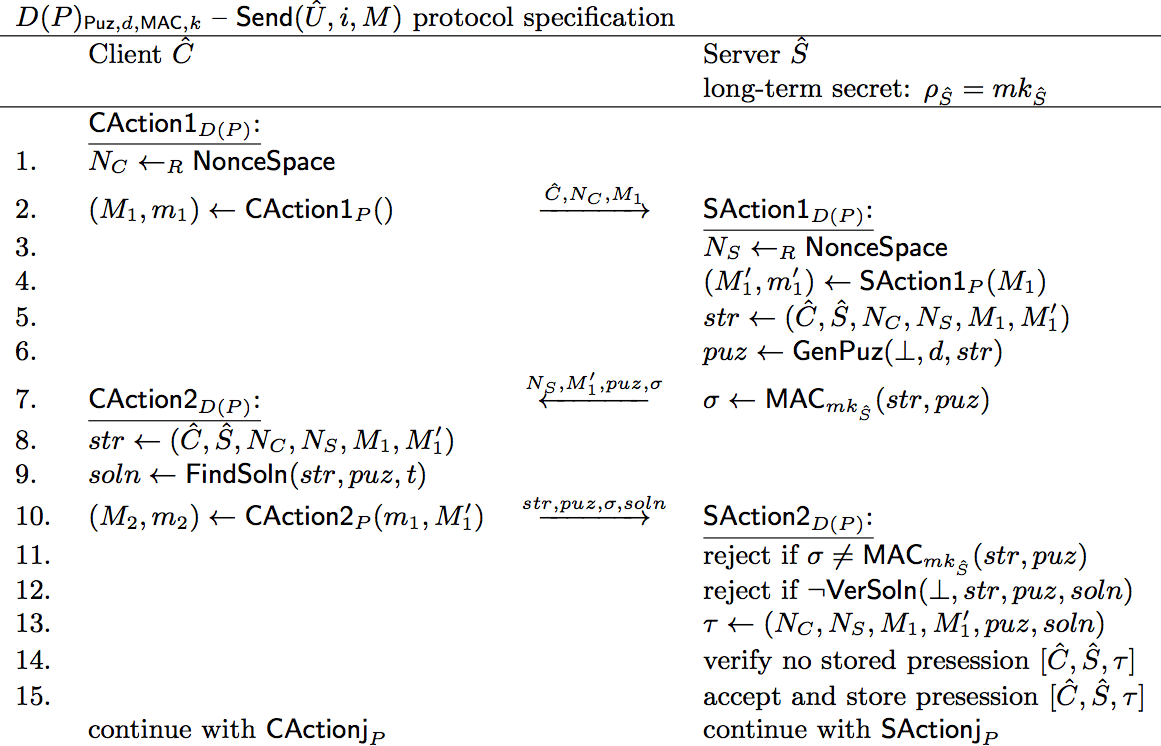
A protocol using strong client puzzles may still not be secure against DoS attacks if the puzzles are not used in a secure manner. We describe a security model for analyzing the DoS resistance of any protocol in the context of client puzzles and give a generic technique for combining any protocol with a strong client puzzle to obtain a DoS-resistant protocol.
Keywords: client puzzles, proof of work, denial of service resistance, protocols
Reference
Douglas Stebila, Lakshmi Kuppusamy, Jothi Rangasamy, Colin Boyd, Juan González Nieto. Stronger difficulty notions for client puzzles and denial-of-service-resistant protocols. In Aggelos Kiayias, editor, Topics in Cryptology — The Cryptographers' Track at the RSA Conference (CT-RSA) 2011, LNCS, vol. 6558, pp. 284-301. Springer, February 2011. Revised February 2013. © Springer.
Download
Presentations
- 2011-02-17: CT-RSA 2011. (PDF slides)
- 2011-01-25: Centre for Advanced Security Research Darmstadt (CASED). (PDF slides)
BibTeX
Funding
This research was supported by:- Australia–India Strategic Research Fund (AISRF) project TA020002